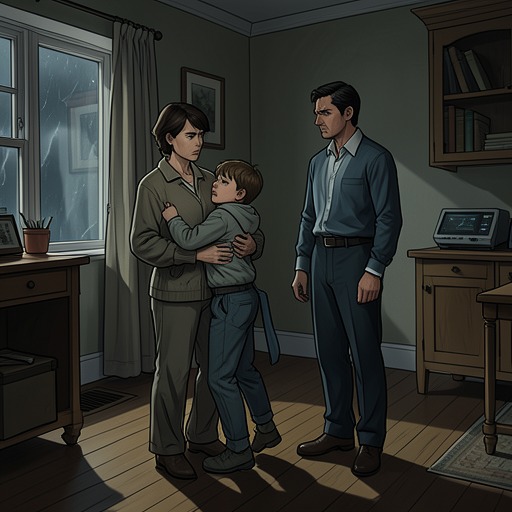
Tony Glick and Marjorie Glick
'Salem's Lot: A NovelTony Glick and Marjorie Glick are the parents of Danny Glick, the twelve-year-old boy whose hospitalization, death, and subsequent disturbance at the cemetery mark a decisive escalation in the horror of Jerusalem’s Lot. Their relationship is defined less by private domestic detail than by a shared parental catastrophe: Danny’s death converts them from a family in mourning into witnesses through whom the town’s inability to understand the supernatural becomes visible. Tony and Marjorie respond differently, but both are overwhelmed by the same loss.
Family and Circumstances
Tony is identified as Danny’s father when he brings the boy to the hospital on September 22, 1975. Danny is admitted with shock, partial loss of memory, nausea, disinterest in food, constipation, and pronounced lethargy. The medical record gives the child’s symptoms an apparently clinical explanation, proposing pernicious anemia, while acknowledging that mental shock may be contributing to his condition. The diagnosis places Tony and Marjorie within the ordinary institutional language of illness, testing, medication, and parental reassurance even as Danny’s condition resists ordinary understanding. The hospital’s provisional explanation does not prevent catastrophe. At one o’clock in the morning on September 24, a nurse enters Danny’s room to administer medication and finds the bed empty, with what appears to be a wasted white bundle collapsed near the foot of the bed. The incident turns Danny’s illness into a mystery before his parents have any meaningful explanation for what has happened. Tony’s role as the admitting parent establishes his immediate responsibility for the child’s care, while Marjorie’s later presence at the funeral shows the family confronting a loss that medicine has failed to contain.
Shared Grief at Danny’s Funeral
Danny’s burial takes place on September 28 at Harmony Hill Cemetery, on the first day of what the narrative calls real fall. A large portion of Jerusalem’s Lot attends: relatives arrive from as far away as Tulsa, Oklahoma, classmates and neighbors join the procession, and the town’s officials, workers, and habitual funeral-goers form a long line of cars with their headlights on despite the brightness of the day. Tony and Marjorie therefore mourn not in private but within the full pressure of small-town attention and collective memory. Marjorie appears in a black coat and veiled black hat, holding a black purse as though it were a life preserver. Her father supports her in a protective curve of his arm while she sways beside him. Tony stands apart, shocked and wandering, repeatedly looking around as if he must verify that he is actually among the mourners. His face suggests a man who believes he is dreaming. The physical separation between the spouses does not indicate separate grief; instead, it gives their shared bereavement two distinct forms. Marjorie is nearly unable to remain upright, while Tony cannot fully accept the reality represented by the coffin. Father Donald Callahan conducts the service and sprinkles holy water over the coffin and grave, an act intended to sanctify them permanently. The ritual places the parents’ suffering within the language of baptism, consolation, eternal life, and Christian hope. Yet the ceremony also carries dramatic irony: the religious gestures are performed against a threat that the congregation does not yet comprehend, and the grave itself will soon become the scene of a crisis between conventional mourning and supernatural return.
Tony’s Denial and Marjorie’s Collapse
The funeral breaks apart when Father Donald Callahan begins the Lord’s Prayer. Tony suddenly screams that no one will throw dirt on his boy and lunges forward. The men attempting to restrain him are too late; the fake grass covering the grave wrinkles and gives way, and Tony falls into the open hole, landing heavily on Danny’s coffin. His protest is not merely disruptive grief. It is a bodily refusal to permit the burial to become final, as though keeping the ritual from completion could keep Danny from being irrevocably dead. After being pulled away, Tony continues to insist that Danny is not dead because he is only twelve years old. He sobs, staggers forward, drops to his knees at Father Donald Callahan’s feet, and grasps the priest’s trousers with muddy hands, pleading for his son to be returned and accusing the adults around him of deceiving him. His words reveal a mind trapped between factual knowledge and emotional impossibility: he has attended the funeral, yet he cannot accept the meaning of the coffin, the grave, or the prayers. The scene makes parental grief an epistemological crisis, not simply an emotion. Tony knows what the ceremony says, but every instinct of fatherhood rejects it. Marjorie’s reaction is quieter but no less extreme. After Tony’s collapse and renewed pleading, she faints. Her body gives way where Tony’s body has charged forward, producing a stark contrast between active denial and helpless physical surrender. Together, their responses form the funeral’s emotional structure: Tony tries to interrupt death, while Marjorie is overcome by it. Neither response allows the church’s orderly language to make the loss bearable.
Relation to the Town’s Buried History
Tony and Marjorie’s grief occurs within a community that preserves old violence through repeated stories, ceremonies, and funerals. Jerusalem’s Lot was incorporated in 1765 and later celebrated its bicentennial with fireworks and a public pageant, but the town’s civic continuity coexists with a long memory for scandal. The Marsten House remains its principal inherited horror, and the town passes its violence from generation to generation even when the people who suffered it are long dead. Tony and Marjorie’s funeral thus becomes another public ritual through which the town records catastrophe, although the meaning of Danny’s death initially remains hidden from the mourners. The town’s historical memory is also incomplete. Four children disappeared between 1928 and 1939 while Hubert Marsten and Birdie Marsten lived in the Marsten House, yet none of the children was ever found. Local knowledge preserves fragments of such events without possessing their full causes. The same pattern governs Danny’s parents: Tony and Marjorie can identify their son’s illness and death, but they cannot yet understand the force that has entered their family. Their mourning is therefore suspended between documented fact and concealed history. This structure echoes the broader revelation that Jerusalem’s Lot conceals secrets even from its own inhabitants. The town knows some violent stories, including that Hubert Marsten killed his wife, but not the circumstances that preceded the murder or the occult correspondence and history surrounding the house. Tony and Marjorie’s loss enters this same pattern of partial knowledge. Their visible sorrow is genuine and fully public, while the supernatural truth behind it remains withheld until other characters begin connecting medical anomalies, missing bodies, and the behavior of the dead.
Narrative Significance
Tony Glick and Marjorie Glick represent the ordinary family at the point where ordinary explanations fail. Danny’s hospital chart reduces his condition to symptoms and a possible diagnosis; the funeral attempts to reduce his death to a Christian rite; Tony’s refusal and Marjorie’s collapse expose the inadequacy of both frameworks to contain what is happening. Their relationship gives the early supernatural plot an intimate human measure before the vampire outbreak becomes a town-wide crisis. Their shared bereavement also establishes a recurring contrast between private attachment and communal ritual. The town attends in force, cars stretching up Burns Road with lights burning in daylight, but public attendance cannot protect the parents from the singularity of losing a child. Father Donald Callahan can offer prayers and holy water, and the mourners can restrain Tony, yet none of these collective actions resolves the parents’ trauma. Tony and Marjorie’s relation is consequently remembered through a moment in which grief overwhelms both social order and religious ceremony: the father falls onto the coffin, the mother faints, and Danny’s burial becomes one of the first unmistakable signs that death in Jerusalem’s Lot will not remain safely contained in the grave.